Categories
blog

Earnest Money in Buying Manila Properties – Should I Or Not? How Much? Safe?

Earnest Money Offer– is a tool that is used when a client is serious about a property. What is it, should I do it, how much, is it safe – these questions almost always require a lot of discussion and education.

What is earnest money and why do I need it? The “book definition” of earnest money is: “A monetary deposit paid by a buyer to a seller to demonstrate intention to complete the purchase.” In the Philippines, it is called Reservation Fee for purchase on pre-selling projects. Earnest Money is a term usually for the secondary or resale market.

In Philippine Real Estate, earnest money is some amount of money, which helps show the seller that a buyer is serious. Earnest money forms part of the payment to the seller.

I  have encountered a lot of clients who do a verbal offer. A verbal offer is done to ‘test the water’. However, verbal offers are so without a foundation that it most likely than not, does not push through. An earnest money is needed to firm up a buyer’s offer. Without earnest money, there is nothing to stop a buyer from submitting offers on multiple properties. Without earnest money, there is nothing to stop a buyer from just walking away from a contract days or weeks after it’s been accepted and the seller has taken their property off the market. Sellers want and need to know that a buyer is serious about the offer on their property. 

How much earnest money do I pay? The simple answer is – “the more the better”. The complicated answer (and one that’s virtually impossible to know in advance) is, ‘whatever it takes to make the seller know you are serious’. Generally speaking, 1% of the offer price is considered a reasonable amount. But like anything in Philippine Real Estate, there are no hard and fast rules. I’ve seen offers written with as little as P1,000 earnest money and as much as 100% of the sales price. That P1,000 was the money of the client on his wallet as he needed time to withdraw from his bank and there were two of them wanting the same property for the same price and terms.

An example may be helpful here. Let’s say a seller gets two offers. They are identical in price, down payment amount, balance payment, etc. But offer #1 has a higher earnest money deposit than offer #2. Regardless of the true motivation of the buyers, the seller will most likely accept the offer with the higher earnest money amount given the term of payment, and price are equal.

Can I lose my earnest money? The short answer is yes. The complete answer is maybe. Again, generally speaking, your earnest money is “safe” unless you default on the contract. Should the seller default, your earnest money will be returned. In the Philippines a normal ‘due diligence’ period is 10 days. If the property you make an offer on doesn’t “pass” inspection on the paperworks – title, tax declaration, CAR, and dues if applicable, the buyer can cancel the contract and get their earnest money back. 

Most earnest money is lost when the buyer backs out after the inspection period. In this case, the seller will almost always retain the buyer’s earnest money.
There’s nothing to be afraid of with earnest money. If you are serious about purchasing a home, you need to indicate to the seller you are serious. If they accept your offer then it would be psychologically a new phase in their lives coming with the memories of that property. They need to know you are serious about completing the sale. That’s why a seller wants to see that you can get a loan, that you aren’t “fishing” with multiple offers, and that you aren’t going to back out at the last minute. A reasonable earnest money deposit helps reassure the seller you are serious about buying their home.


Categories
blog

Which Developer Should I Join To Sell Faster?

Many newcomers who are entering the Philippine Real Estate business have been asking me and recently on my last seminar for real estate agents, “Which Developer Should I Join To Sell Faster?”

Photo AFP

The question does not have a quick answer but rather has more questions to the person entering the field than the developers who are already in it. The consistent success of a real estate agent is dependent on his/her ability to be credible. Since sales is a fast paced environment – words are used to communicate information. The credible real estate salesperson is  someone who will be consistent in correct information from start of inquiry up until the property is turned over and until the title and tax declaration is under the buyer’s name already. Some very fast paced developers have instructed their agents who are selling properties on the pre-selling stage to just concentrate on getting reservations only and another backend team will be the one to take care of the rest (of the process). Comment: While this increases reservation on a monthly basis, it also increases backouts foand

Are Ayala real estate agents selling? Yes. Are Megaworld agents selling? Yes. Are Rockwell agents selling? Yes. Are Filinvest agents selling? Yes. Are Century Properties agents selling? Yes. Are the brokerage houses like C&G Properties selling? Yes yes yes!

There are other developers whether classified as big, medium, small or new who sell and whose agents are earning and selling. Why? On the other spectrum is there are agents, who join these winning groups but do not make a sale. Why?

The answer is on matching. It may be a simple word but it is by no means a simple process.

What are some tips that may help you sell faster and consistently?

1. Philippine real estate selling should be first and foremost approached as a business rather as an employment. It is a success-based enterprise more than a high paying corporate career that can be relied on comfortably on a monthly basis. It is rather approached as a day to day opportunity to earn and make better than those who are taking the path of corporate employment;

2. Developers and their products should be viewed as an inventory to be carried that will help people in one’s social circle. Yes, the people who venture into real estate selling ( no matter the age) makes the process easier if the product they have and the social circle they are into matches. Later on, as the skills and knowledge develop, the social penetration may move towards the upward spectrum.

3. There is no turning off the process of prospecting. Simply put, wherever and whenever you are, always check if there are buyers who may buy, people who may refer or other agents to collaborate with;

4. Prayer. I got my personal talk with God recently while I was talking with my five year old son. He woke up and went to the kitchen where I was eating breakfast and told me, rather commanded me, “Dad, open the tv I will watch Disney Junior.” I told him, “David, your food first.” He replied with a rather irritated answer, “Dad…. I want to watch Disney…” and again I told him to ‘eat first’ then he started giving a sort of crying sound with, “I want to watch now…..” And I said, “David, please eat your food first and when you have eaten, then you will study then you may be able to watch your show.” Then I said, “David, you have to follow me because I know what is best for you and if you follow me then I will take care of you always.” Then I realized that God is saying the very exact thing to me. Glenn, do not go ahead of me and tell me what you want to do. Do not just give me your plans and ask me to bless it. Ask me what I want you to do and I will give everything you need to make it happen.

Categories
blog

Real Estate Closing Costs – Taxes and Fees in the Philippines

A sale is not finished until the tax declaration is transferred in the name of the new owner.

When I started my project selling career around 15 years ago I was with a developer who did majority of the paperworks as its service to both their marketing and their buyers as well – this included paying the necessary taxes after the client pays the whole amount already. This process helps an agent concentrate on getting the next client as every moment should be focused on prospecting and closing rather than on  paying taxes, waiting for release of papers, dealing with government agencies and other items which could be outsourced to another department.

Inhouse sellers are focused on getting reservations, downpayments and payments for the balance through either, inhouse, bank or even the government’s Pag-ibig financing. Since also, full payments happen 3-5 years down the road for pre-selling projects – there is not a need to learn the process.

Doing full brokerage requires learning the full real estate cycle and especially the taxes and fees for the closing of the deal. As we all know, there are taxes that need to be paid when a real estate property is sold.

WHAT ARE THE USUAL FEES THAT A SELLER NEEDS TO PAY?

The standard procedure  is that Capital Gains Tax ( if seller is an individual ), Creditable Withholding Tax ( if seller is a corporation ), Broker’s Professional Fees ( if applicable ) are for the Seller’s account. There are instances when a seller would give a NET price excluding the above fees. Here is where a broker should be careful in analyzing what types of fees s/he should include in the computation. I have personally encountered sellers whose property is under a corporation but was not disclosed offhand. Only when I got the title for due diligence did I see that the property was under a corporation. This of course, changed the selling price of the property. I will write more about taxes for a corporation on my next article.

WHAT ARE THE USUAL FEES THAT A BUYER NEEDS TO PAY?

The Buyer then pays for the Documentary Stamps Tax, Transfer Tax, Registration Fees, Notarial Fees and any transfer related charges. The problem I’ve encountered is that the computation is sometimes inaccurate and the payees of the manager’s checks payable for the corresponding taxes to the Bureau of Internal Revenue , City Treasurer and Register of Deeds are erroneous.  What’s worse is that the amounts are also incorrect.   This causes delay and frustration on all parties concerned, particularly the Seller and Buyer.

WHAT IS THE PROPER PROCEDURE?

(The proper procedure is to have the computation done by the respective agencies.

Bureau of Internal Revenue (BIR)

For capital gains tax / creditable withholding tax, 6% is the normal tax imposed ( by the way, capital gains tax in the Philippines doesn’t necessarily mean that a gain was made by the seller, it’s just a terminology used by the government, it should actually be called sales tax ). I actually had a client who bought a property at 9M and sold at 8M. However zonal value is computed at 10,000,000, he said that he did not gain from the transaction so there should not be a tax anymore. But government says anything that gets sold – there is a gain.

The documentary stamps tax ( 1.5% ) is also computed ( most errors i’ve seen here is when the amount is rounded off which causes a disparity in amount ).  An officer of the day ( ONETT ) will assist you, a deed of sale must be shown together with a  copy of both the title and tax declaration for then get the zonal value as the tax is computed on either selling price or zonal value whichever is higher.

City Treasurer

For the Transfer Tax, proceed to the City Treasurer as the computation varies for  in some cities.  They vary from .5% to a high of .75% of zonal value or selling price whichever is higher.

Register of Deeds

Finally, proceed to Register of Deeds for the Registration Fees.  This one is tougher to compute as they use a table based on the amount of sale involved and add on other figures to come out with the final Registration Fee amount.

All checks payable to Bureau of Internal Revenue, City Treasurer and Register of Deeds have to in a Manager’s Check.  Please ask them the proper way of wording the payees as FAO and IFO have to be included in the names of the payees.

By the way, zonal values can be looked up at the website of BIR ( www.bir.gov.ph ).  If you have time to hold, you may call BIR at (632) 981-8888.

Thanks for your time, hope this could somehow guide you in your future deals.  Till the next blog.   Best regards ….

Glennis

Categories
blog

Property Buying Process In The Philippines

I have been doing consultancy for different developers in the Philippines and an item that a developer wants to decrease is back outs due to inability to pay of a client. With stretched downpayments of 3,4,5 and even 6-year-payment terms, a buyer’s monthly investment of Php8,000 to Php15,000 is very affordable and manageable. This downpayment terms range from 10,20 or 30% equity of the total amount. Thus, after the specified term, a buyer will have to pay the balance from 90, 80, or 70% of the remaining price. 

Sample: A Bonifacio Global City condominium with the size of 36.5 sqm and selling at Php100,000/sqm. The value of the property becomes Php3,650,000.00. Take 20% of that amount (Php730,000) and spread it over 5 years or 60 months. You will get an equal monthly payment of Php12,167.00. The balance of 80% will be paid after 60 months (Php2,920,000). A developer may offer an 18% interest for 5 years or (P74,138/mo) or 21% interest for 10 years (Php58,370). This is a long jump form the downpayment. Thus, there are backouts. Depending on the cash flow of the developer – this may be both a good and bad position. 

From the buyer’s standpoint, or any person for that matter, – losing money is never a good option. A buyer may re-sell but depending on a lot of factors, even selling at a bargain may not be acceptable for the secondary market. 

I Need a Property That is Already Ready For Occupancy

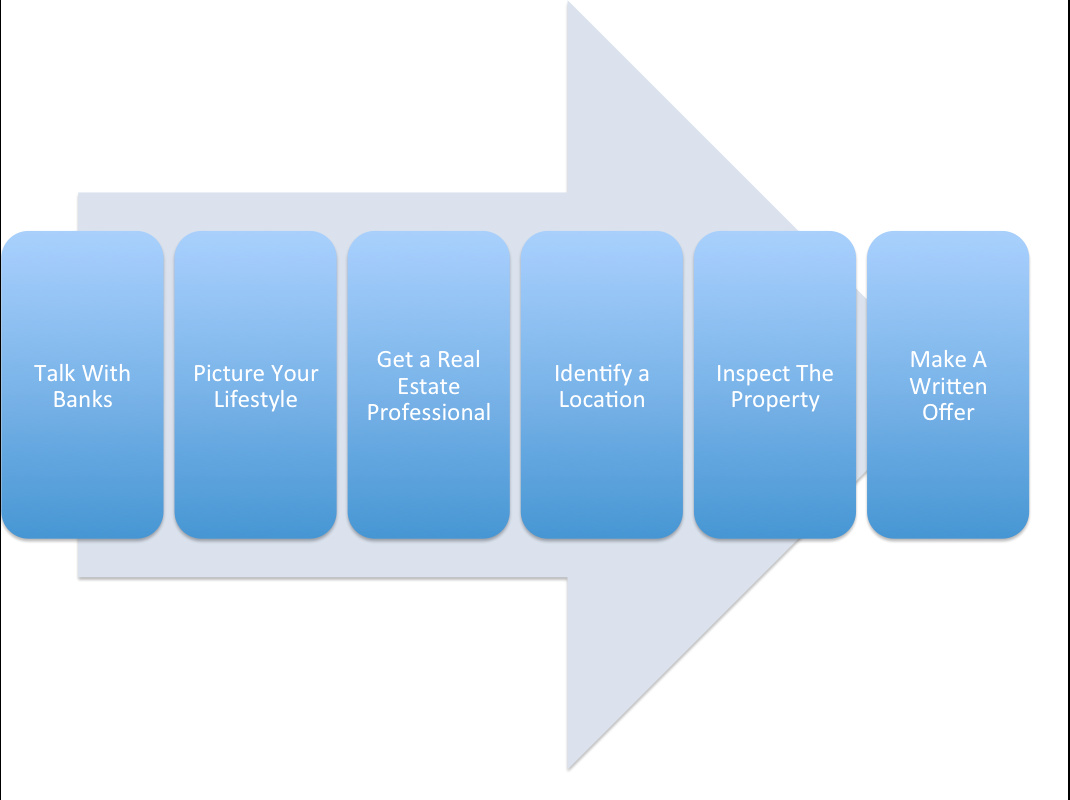
If you are buying a property that is ready for occupancy then the best option that you should do is do the correct steps. For OFWs, balikbayans, retirees, businessmen and most of us for that matter – buying a property is the most expensive purchase in our life. It is best to be in a position to negotiate when you are prepared. We are often asked about the process in the Philippines and I thought it might be helpful for home buyers to have an actual list with some references. Whether you’re a home buying first-timer or you’ve purchased a property before the process is pretty much the same:

1. Talk to Banks
2. Picture Your Lifestyle
3. Choose Your Real Estate Professsional That Will Work For You
4. Identify a Location
5. View The Property
6. Make an Offer In Writing

Philippine Sales Process

Talk To Banks. This very important first step is sometimes skipped over by even the experienced buyer. Nothing can be more disappointing than finding a property that you love only to realize that you either cannot obtain a loan or you cannot afford the payment for that property. Banks offer a lot of flexible payments from a fixed rate to a very low interest. 

Picture Your Lifestyle. Why are you buying this property again? Does it replace your car, will it give twice business, does it multiply your ‘time’?  Some amenities can be difficult to locate in some price ranges. Knowing why you are buying can be very helpful when beginning your home search.

Choose a Real Estate Professional
. Choosing the right licensed broker to represent you can make the rest of the process easier. Philippine Real estate agents and brokers are NOT all the same. In the Philippines, there are also a lot of colorum or unlicensed agents and practitioners calling themselves brokers.  Experience and expertise can vary GREATLY! Is your agent doing this full time or only on weekends? Is your next door neighbor or the agent you met at the mall really the best choice for you? A common mistake is that a potential buyer will locate the property before locating a licensed broker. You need to work with somebody whom you like and will represent you. I have been blessed to get inquiries and referrals who will ask for some advice on purchases in the Philippines. Sometimes, their requirement is not available in the market in the price that they want or in the orientation they prefer (e.g. facing east, facing SouthEast). When we have pinpointed their location we concentrate our efforts there. When they are the ones who will find a property – they will call me to check it out and represent them. This is both good for my business and also for theirs as I will make sure that they get the best deal.

It also happens that a buyer will call directly a property with a “For Sale” number. However, most of the time, the person with that number already has an agreement to represent the best interests of the seller. Although they can help you purchase the property it is extremely difficult for one agent to give their best representation to both parties.

I LIKE THE PROPERTY BUT NOT THE SELLER

Another problem we often see with first time buyers is that they view a lot of properties with a number of different agents. Once you have been shown a home by a broker, that broker is considered to be working with you for that particular property. This can be a difficult situation if you locate the perfect home but you happen to be with a broker you don’t feel comfortable working with. Get a real estate professional who will represent you first.

Make An Offer In Writing

There are times when a seller would reconsider something with an earnest money and written offer. It shows sincerity and professionalism which a seller may appreciate.

Categories
blog

7 Reasons Why Project Selling Is the Better Route To Start A Real Estate Career

7 Reasons Why Project Selling Is the Better Route To Start A Real Estate Career

New brokers and agents have asked me where to start their real estate selling career. Do they enter brokerage or project selling?

If you are new in the business and good at working with teams and meeting deadlines then project selling is the way to go. There are different skills set needed to be good in brokerage and also in project selling. Today I will write about project selling and the “7 Reasons Why Project Selling Is the Best Route To Start A Real Estate Career.” 

Project Selling is the best way to enter the real estate world for the following reasons:

  1. The Developer takes care of promoting the project through its marketing efforts that include both below and above the line advertising. They put their numbers on the ads and an in-house seller is assigned to answer the queries;
  2. The Developer carries itself its own brand that helps sell a project (let’s say it has a good brand already);
  3.  The Developer gives monthly support in the form of allowances and also incentives when desired goals are met;
  4. The Developer hires trainers to help an agent familiarize himself to the process of selling and project details and the trainers also help out by giving tips on how to sell better
  5. Seminars are also regularly given to sharpen the selling skills of the agents
  6. Nowadays, it is normal for a developer to help its team identify their specific target market and do activities to reach the specified target;
  7. Developers augment cost in reaching the clients. This include paying for marketing collaterals like the nice brochures, flyers and online materials that could be used to get clients or to service a prospect;
  8. Developers help soften a prospect’s resistance by having large ads in major newspaper and also by having website ads and other events that sends the message “We have money – we can build this project”;
  9. Project Selling usually have good structures of sales manager -sales agent teams that help each other in hitting the desired goal. If you are new it is best to learn from other people’s experiences.

Ask a seller how they learned how to sell. Good Real Estate Developers will train its sellers and make the process of getting a client and closing a sale shorter. You need to make this process as short as possible and as frequent as possible since goals are time bounded and the faster you learn this the easier it is to repeat! A sample good developer that takes care of its team is Ayala Land whether its Premier, Alveo, Avida or Amaia. They have trainings that transforms a person from a newbie to a champion seller!

It is always best to look for mentors who will push you to better yourself and better your performance day after day. After all, this is sales and just like Lebron James of Miami Heat needs to score game after game – we need to sell month after month! My mentor in project selling Philip Cristobal, who brought in the Philippines The Tom Hopkins Selling, always asked me, “Glennis, Is This The Most Productive Thing You Can Do At This Given Time?” This will always put me in the moment of how I should manage my time whether when I was just starting an agent and when I also handle a marketing arm.

Many hands make light work.